Two Sessions: China Targets 5% Growth, 12 Million Jobs in 2026
Opening China’s annual policy meetings, Premier Li Qiang pledged wider market access and progress on new trade agreements.
Sixth Tone
By Fan Yiying
Mar 05, 2026 | 457 words | ★★☆☆☆
China has set a growth target of “around 5%” for 2026 and plans to create more than 12m new urban jobs, Premier Li Qiang announced on March 6th at the country’s annual “Two Sessions” meetings, the political gatherings that chart China’s economic and policy agenda each spring.
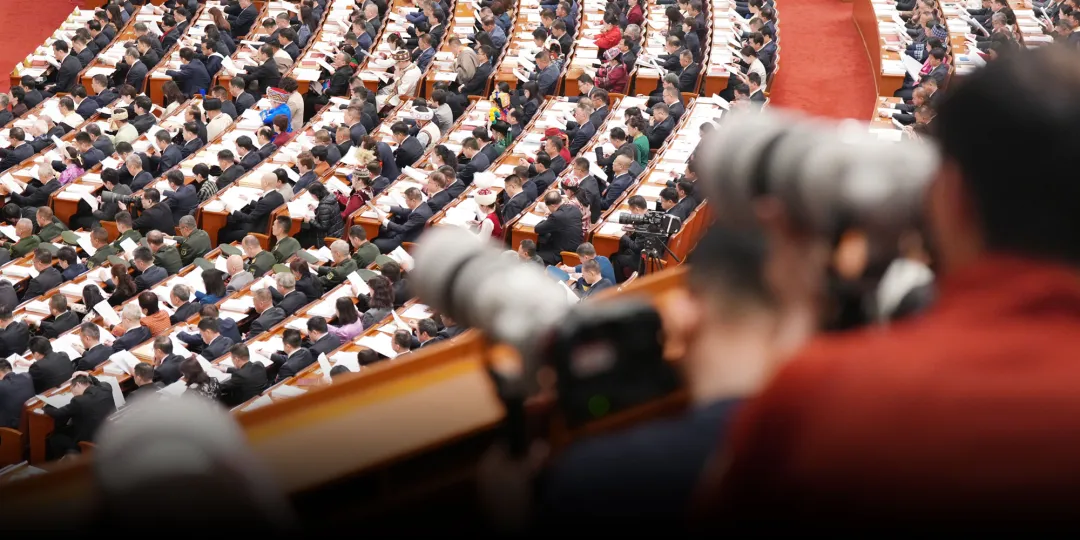
Delivering the government work report at the Great Hall of the People in Beijing, Mr Li acknowledged the country’s recent achievements but cautioned against complacency. China must, he said, remain clear-eyed about the difficulties that lie ahead.
“Changes in the external environment are having a growing impact,” he warned, pointing to rising geopolitical tensions, weakening global economic momentum and mounting challenges to multilateralism and free trade. At home, he added, China still faces longstanding structural problems alongside fresh pressures as the economy continues its transition.
The “Two Sessions”, known in Chinese as lianghui, bring together the National People’s Congress, China’s legislature, and the Chinese People’s Political Consultative Conference, a political advisory body. The meetings are held each spring and serve as the main platform for setting the country’s economic, social and political priorities for the year ahead.
China’s economy expanded by 5% in 2025, reaching more than 140trn yuan ($20trn), Mr Li said in the report. Over 12m new urban jobs were created last year, while the surveyed urban unemployment rate averaged 5.2%.
China also intends to press ahead with further opening. “We will expand market access and open up more areas, particularly in the service sector,” Mr Li said. He added that the government would shorten the “negative list” governing cross-border trade in services and push forward negotiations on additional regional and bilateral trade and investment agreements.
Fiscal policy will remain supportive. The government plans to keep the deficit-to-GDP ratio at roughly 4%, with the fiscal deficit set at 5.89trn yuan, 230bn yuan higher than last year. Total public spending is projected to exceed 30trn yuan for the first time.
Stimulating domestic consumption remains a central objective. Mr Li announced a fiscal package of 100bn yuan aimed at boosting household demand, alongside more than 250bn yuan in “ultra-long-term special treasury bonds” to support consumer-goods trade-in programmes.
For the first time, the government work report also proposed measures to raise incomes more broadly. The plan includes increasing earnings for lower-income groups, expanding property income and improving wage and social-security systems.
Authorities also pledged greater support for healthcare, pensions and childcare. Measures include higher subsidies for medical insurance and expanded development of affordable childcare services, steps officials say are intended to strengthen consumers’ spending power.
Mr Li also emphasised the importance of accelerating the development of emerging industries. These include integrated circuits, aerospace, biomedicine and the so-called “low-altitude economy”, a sector encompassing drones and other aerial technologies operating at lower airspace. ■